Ⅰ.Price Storm: Latest Quotations and Trends of Tungsten Products in 2026
(I) Core Product Quotations (Xiamen FOB, March 17, 2026)
Data Source: Chinatungsten Online, Released on March 17, 2026,
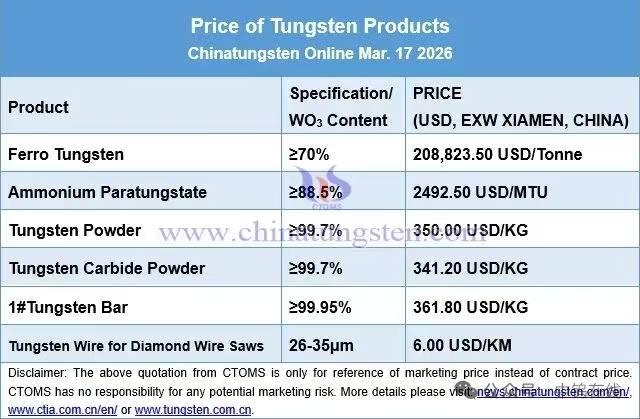
According to the latest quotations, the prices of core raw materials for cemented carbide such as tungsten carbide powder and tungsten rods have reached historical highs:
- Tungsten Carbide Powder (≥99.7%): 341.20 USD/KG
- Grade 1 Tungsten Rod (≥99.95%): 361.80 USD/KG
- Ammonium Paratungstate (APT, ≥88.5%): 2492.50 USD/MTU
- Tungsten Iron Alloy (≥70%): 208,823.50 USD/Tonne
(II) Price Trend Analysis (2025-2026)
*Data Source: Chinatungsten Online & CTIA GROUP, Released on March 17, 2026
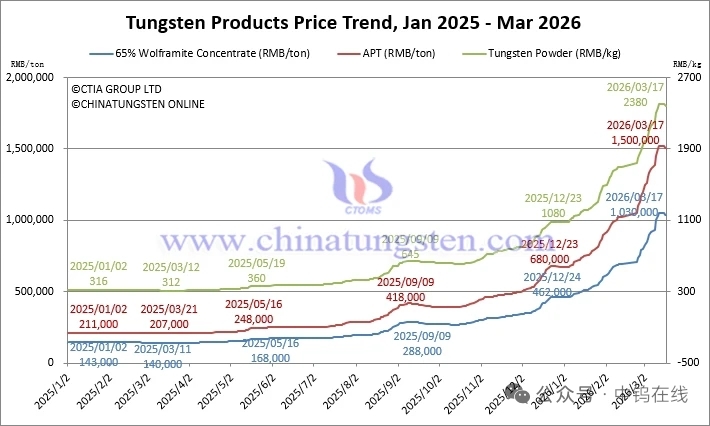
Tungsten product prices remained stable throughout 2025 and saw a cliff-like surge after entering 2026:
- Tungsten Carbide Powder: Surged from 680 RMB/kg in December 2025 to 2380 RMB/kg in March 2026, an increase of over 250%
- APT: Rose from 462,000 RMB/tonne to 1,500,000 RMB/tonne, an increase of over 224%
- 65% Tungsten Concentrate: Exceeded 1,030,000 RMB/tonne, hitting a two-year high and becoming the core driver of this round of price increases
Ⅱ. Root Causes of Price Increase: Reconstruction of Global Tungsten Industry Chain Supply-Demand Pattern
1.Supply Side: Resource Scarcity and Production Capacity Contraction
Global tungsten resources are highly concentrated in China (accounting for over 60%), but the grade of domestic tungsten ore has been continuously declining, significantly increasing the mining cost of low-grade ore. At the same time, environmental protection production restrictions and capacity control policies have been tightened, leading to production restrictions and shutdowns of small and medium-sized smelters, resulting in a persistent expansion of the supply gap for deep-processed products such as tungsten carbide powder. The progress of overseas tungsten ore development is slow, and geopolitical conflicts have further affected transportation and production capacity release, keeping the global supply side tight.
2. Demand Side: Dual Driving Force from High-End Manufacturing and Downstream Recovery
The demand for cemented carbide tools and precision components in high-end manufacturing fields such as new energy vehicles and aerospace has surged, directly consuming a large amount of tungsten carbide powder. Meanwhile, with the recovery of the global infrastructure and home furnishing industries in the post-pandemic era, the demand for tungsten-based tools in wood processing (solid wood, panels) and non-ferrous metal processing (aluminum, copper) has steadily increased, and the demand for tungsten wire for diamond wire saws used in photovoltaic silicon wafer cutting has also risen simultaneously. The supply-demand mismatch has further pushed up prices.
3.Macroeconomic Factors: Cost Transmission and Exchange Rate Fluctuations
The rising prices of energy and chemical raw materials have increased the energy consumption and auxiliary material costs in the tungsten carbide production process; the fluctuations of the RMB against the US dollar have put pressure on the costs of export-oriented tungsten enterprises, and the FOB quotations have been adjusted upward simultaneously, which are ultimately transmitted to terminal processing enterprises.
Ⅲ. Industry Breakthrough: Practical Strategies for Distributors, Processing Factories and Workshops
(I) Distributors: Optimize Supply Chain and Lock in Long-Term Customers
- "Hierarchical Inventory Management" : Maintain safe inventory for high-frequency consumables (such as ordinary tungsten steel tools), and adopt "small-batch, multi-batch" replenishment for high-end customized products to avoid occupying funds by hoarding goods at high prices
- "Diversified Supply Chain Layout" : In addition to domestic leading tungsten enterprises, expand high-quality tungsten raw material suppliers in Southeast Asia and Africa, and reduce procurement and logistics costs through overseas warehouses
- "Long-Term Cooperation Binding" : Sign tiered pricing supply agreements with wood processing factories and non-ferrous metal processing factories, adjust prices according to purchase volume, and lock in core customers
(II) Processing Factories: Process Upgrade + Tool Selection to Hedge Cost Pressure
Wood Processing Industry
- "Process Optimization": Promote high-speed cutting technology to reduce the single-shift tool loss rate from 3% to 1.5%; introduce CNC machining centers to improve tool service life
- "Tool Selection": Prioritize TCT cemented carbide tools for softwood processing, balancing cost and durability; upgrade to PCD polycrystalline diamond tools for hardwood/particleboard/MDF processing, and offset the high one-time purchase price through long service life
- "Tool Reuse": Cooperate with professional tool regrinding factories to increase the regrinding times of ordinary tungsten steel tools to 3-5 times, extending their service life
Non-Ferrous Metal (Aluminum, Copper) Processing Industry
- "Process Improvement": Adopt dry cutting + minimum quantity lubrication (MQL) technology for aluminum processing to reduce adhesion and wear; optimize cutting parameters for copper processing to adapt to material ductility
- "Tool Replacement”: Select coated cemented carbide tools (TiAlN coating) for batch ordinary aluminum processing; select PCD tools for high-precision processing to solve the problems of chipping and short service life
- "Scrap Recycling”: Establish an aluminum chip and copper chip recycling system to reduce raw material loss costs through reprocessing
(III) Workshops: Refined Operation and Focus on High-Value-Added Scenarios
- "Segmented Track Focus": Avoid low-margin standardized processing and focus on high-value-added small-batch orders such as solid wood special-shaped parts and precision aluminum parts
- "Equipment Lightweight": Introduce small CNC engraving machines and precision sawing machines to reduce unit product energy consumption and equipment depreciation
- "Tool Data Management": Establish a tool usage ledger to record the service life of tools for different materials and processes, and optimize selection and procurement frequency
Ⅳ. Core Guide for Tool Selection: Adaptation Scenarios and Cost Optimization of TCT and PCD
Against the background of high tungsten prices, tool selection directly determines the processing cost of enterprises. As mainstream categories, TCT (cemented carbide tools) and PCD (polycrystalline diamond tools) do not need to be blindly replaced. They need to be scientifically adapted according to processing scenarios and batch requirements to achieve a balance between cost and efficiency, which is also one of the core breakthroughs for cost reduction in the current industry.
(I) Core Adaptation Scenarios of TCT and PCD Tools
|
Tool Type
|
Core Advantages
|
Adapted Processing Materials
|
Adapted Processing Scenarios
|
|
TCT Cemented Carbide Tools
|
Low one-time purchase cost, wide adaptability, and convenient replacement
|
Softwood (pine, fir), ordinary aluminum, small-batch copper
|
Small-batch orders, temporary processing, auxiliary processes (rough cutting, edge trimming)
|
|
PCD Polycrystalline Diamond Tools
|
High hardness, strong wear resistance, long service life, and high processing precision
|
Hardwood (oak, walnut), particleboard, MDF, large-batch aluminum/copper
|
Large-batch orders, core processes (cutting, precision cutting), high-precision processing
|
(II) Core Logic of Cost Optimization
According to industry practical application data, the hardness of diamond (HV7000-8000) is much higher than that of cemented carbide (HV1500-2000). For non-ferrous metal and wood processing, the theoretical service life of PCD tools is 30-300 times that of TCT tools. Affected by processing parameters and equipment precision, the actual service life difference is stable at 30-70 times. The core logic of cost optimization is as follows:
- Small-batch processing (single processing volume < 1000 pieces): Prioritize TCT tools to control one-time purchase cost and avoid cost waste of high-end tools
- Large-batch processing (single processing volume > 1000 pieces): Prioritize PCD tools to amortize unit processing cost through ultra-long service life, which can reduce tool purchase cost by 30%-70% in the long run
- Mixed selection plan: Use PCD tools for core processes to ensure precision and efficiency, and TCT tools for auxiliary processes to control costs, achieving dual balance of "cost reduction + flexibility"
Future Outlook: Industry Trends (2026-2027)
1. Price Trend
- **Short-Term (First Half of 2026)**: The supply gap and rigid demand will support prices to remain high, and the prices of tungsten carbide powder and APT will not drop significantly
- **Medium-Term (Second Half of 2026)**: New domestic tungsten ore production capacity will be gradually released, and overseas projects will be put into operation, with prices expected to回调 by 10%-15%
- **Long-Term (2027)**: The scarcity of resources will become prominent, the price center will move up, and tungsten carbide powder is expected to stabilize in the range of 250-300 RMB/kg
2. Industry Development Direction
- Diversification of Tool Materials: CBN cubic boron nitride tools will replace some cemented carbide tools in the field of ferrous metal processing, enriching the selection range
- Acceleration of Domestic Substitution: Domestic high-end PCD and tungsten carbide tool brands are emerging, with increasingly mature technology, gradually reducing the premium of overseas brands and lowering the purchase cost of small and medium-sized enterprises
Green Production: Energy-saving technology and scrap recycling have become the core direction of cost reduction in the entire industrial chain. Tungsten enterprises and processing enterprises will work together to promote low-carbon transformation and improve the industry's risk resistance capacity.
Related Resources & Recommended
To help you make better tool choices and control processing costs under high tungsten prices, we’ve prepared these practical resources for you:
Looking for a customized tool solution or cost optimization proposal?
Feel free to contact our expert team for a free assessment.

 Groupe d'outillage DiZiK Co., Ltd.
 Téléphone : +86-2882601660
 Mobile : +86-18884256825
 No.1432-1436, section sud de l'avenue Jinxiu, district de Wengjiang, Chengdu, Chine. 611130
 info@diziktool.com


